Builder's Risk for Mass Timber & Glulam: What's Actually Covered (and What Isn't)
By Josh Cotner
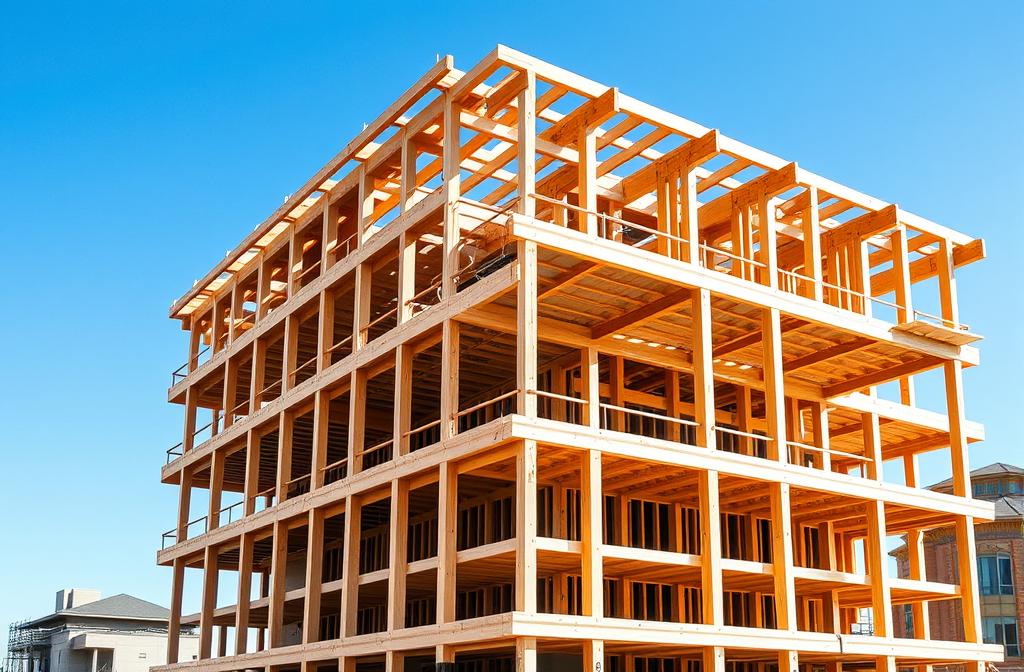
If you erect glulam, cross-laminated timber (CLT), or nail-laminated timber (NLT) on a commercial project, you've probably already discovered that builder's risk for mass-timber construction is harder to place than builder's risk for a steel or concrete building. That's not because mass timber is inherently more dangerous — modern mass timber performs well in fire tests thanks to controlled charring behavior. It's because exposed mass-timber framing during the construction phase is a recognized fire exposure, and many standard builder's-risk carriers are cautious about writing it.
This matters because an uninsured loss during construction — a fire in the framing, a theft of materials, storm damage to an open structure — can fall back on your company if the contract puts the builder's risk obligation on you. Understanding what a real mass-timber builder's risk policy covers (and what it doesn't) is how you avoid that outcome.
What builder's risk actually covers
A course-of-construction (builder's risk) policy insures the structure and the materials going into it during the construction period, from groundbreaking through project closeout. A well-written mass-timber builder's risk policy covers:
- Fire and lightning damage during construction — the critical mass-timber exposure, especially during the open-framing phase before enclosing
- Theft and vandalism of glulam members, CLT panels, and other materials
- Wind and weather damage to the structure while it's exposed
- The installed work itself — your glulam framing, CLT, NLT, and connection materials once they're in place
- Soft costs and delay considerations on larger projects, recognizing that a construction loss also delays revenue and creates carrying costs
Why mass timber gets scrutinized on fire
The fire exposure during construction is the reason mass-timber builder's risk is a specialty line. Here's the nuance: finished, enclosed mass timber behaves well in fire — the outer layer of wood chars predictably and protects the structural core, which is why building codes permit tall mass-timber buildings. But exposed mass-timber framing during construction, before the building is enclosed and before fire-protection systems are active, is a different risk picture. A fire that starts in exposed framing has fuel and no suppression.
This is a real, recognized exposure, and it's why experienced builder's-risk carriers underwrite mass-timber projects carefully — looking at site security, hot-work controls, the construction sequence (how quickly the building gets enclosed), and the fire-protection plan during construction. Carriers that don't understand mass timber either decline the risk or price it defensively. Carriers that do understand it price it rationally and write it.
What's typically not covered (and how to close the gaps)
Standard builder's risk has exclusions you need to know about:
- Earthquake and flood are usually excluded unless added by endorsement. If your mass-timber project is in a seismic zone or a floodplain, you need to confirm these are covered.
- Ordinary wear and tear, faulty workmanship, and defective design are typically excluded — those are professional liability / E&O or workmanship matters, not builder's risk.
- Equipment and tools belonging to the contractor are generally a separate inland marine matter, not builder's risk.
- Third-party liability (bodily injury to others) is not builder's risk — that's your general liability.
A complete mass-timber construction program pairs builder's risk with GL, inland marine for the crane and rigging, and (if you carry design responsibility) professional liability. The builder's risk covers the structure; the other lines cover everything else that can go wrong during erection.
Who carries it — you, the GC, or the owner?
This is governed entirely by the construction contract, and it's where a lot of disputes originate. On many mass-timber projects the owner or the general contractor carries the builder's risk, and you as the erection subcontractor are named as an additional insured under their policy. But:
- Some contracts push the builder's risk obligation onto the erection subcontractor, especially on smaller or design-build projects
- Even when the owner or GC carries it, ambiguity about who insures the installed glulam between delivery and final acceptance can leave a gap
- If the primary builder's risk has a mass-timber exclusion or sub-limit buried in it, you may be relying on coverage that won't fully respond
Read the insurance requirements in your contract carefully. If builder's risk is on you, or if there's any ambiguity, bind your own coverage with a carrier that understands mass-timber construction. The premium is a fraction of what an uncovered construction fire would cost.
Start the conversation before groundbreaking
The single most useful thing you can do is start the builder's risk conversation before the project breaks ground. Once framing is going up, you're already in the highest-exposure window, and placing coverage mid-project with a real mass-timber carrier is harder and more expensive. Bring us in during preconstruction — we'll read the contract's insurance requirements, structure the coverage with a carrier that writes mass timber, and make sure the limits, the exclusions, and the additional-insured endorsements match what the project actually demands.
We place builder's risk for mass-timber and glulam projects across the country, from single timber-frame structures to large commercial and civic buildings. If you have a project coming up, the earlier we see the contract the better the coverage and the better the price.
Need this coverage for your glulam operation?
Get a real quote in about 15 minutes — we shop specialty markets that actually write engineered-wood fabrication and mass-timber construction.