Workers' Comp Class Codes for Glulam Fabricators & Mass-Timber Contractors
By Josh Cotner
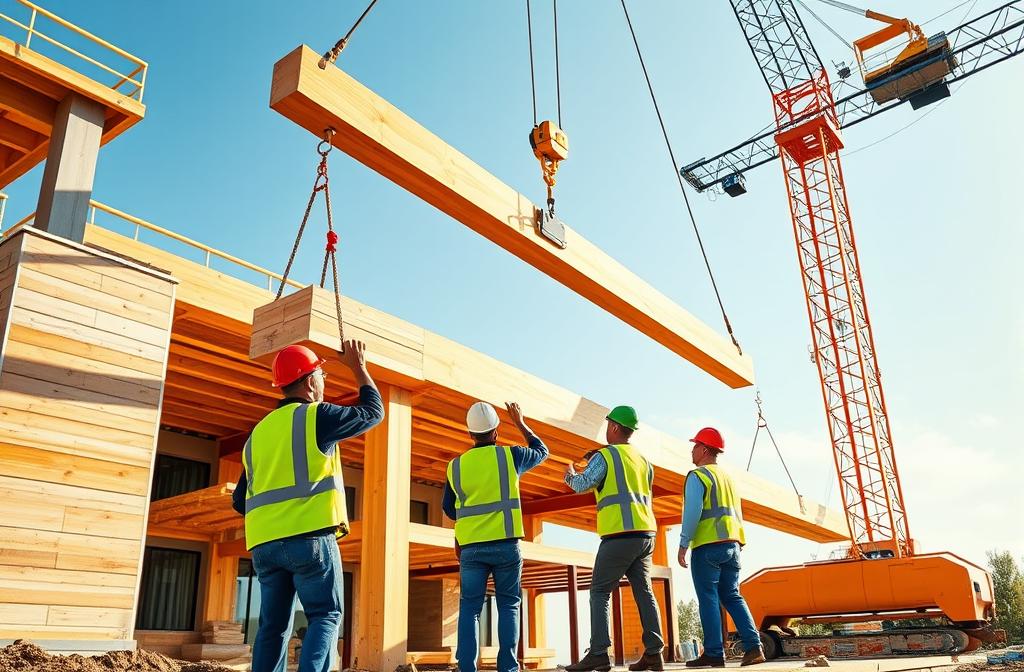
Workers' compensation is one of those insurance lines where the details quietly cost (or save) you real money every year — and for glulam fabricators and mass-timber contractors, the details matter more than almost anywhere else. The reason is class codes: the numeric codes that describe what each employee actually does, which drive the rate you pay per hundred dollars of payroll. Get them wrong and you either overpay for years or find a claim disputed on a technicality.
Shop work and field work are rated differently
The core thing to understand is that glulam fabrication (shop work) and mass-timber erection (field work) carry very different hazard exposures, and the workers' comp system reflects that.
Manufacturing laminated wood members — running presses, saws, and finishing lines inside a controlled plant — is a lower-severity machinery exposure. The class codes and rates for that work reflect a relatively contained environment with predictable equipment hazards.
Mass-timber erection — lifting heavy beams, working at height, operating around cranes and rigging on an open jobsite — is a higher-severity exposure. Falls, crush injuries, and lift strains are more frequent and more severe. The class codes and rates reflect that.
The expensive mistake: misclassifying payroll
The most common (and most expensive) mistake is rating fabrication crews as field erection crews, or vice versa. If you rate your shop crews at field erection rates, you overpay — sometimes substantially — every single year. If you rate your erection crews at shop rates, you underpay, and when a serious field injury happens, the carrier can dispute the claim on the grounds that the payroll was misclassified.
For operations that do both — fabricate in the plant and erect in the field — the right structure is to split payroll cleanly between shop class codes and field class codes. That requires disciplined timekeeping that separates the hours each employee spends in the plant from the hours they spend on a jobsite, and it requires an agent who knows the engineered-wood class code landscape well enough to assign them correctly.
The real injury patterns in glulam
Beyond the class codes, it's worth understanding the injury patterns we actually see in this trade, because they drive both your experience modifier and your ability to place coverage at a reasonable rate:
In the fabrication shop:
- Press and machinery injuries — pinch points, crush injuries, and caught-in hazards around laminating presses and saw lines
- Saw lacerations — finger and hand injuries from timber saws and CNC equipment
- Lift and strain injuries — repetitive lifting of lumber and handling of partially-finished members
- Chemical exposure — adhesive and resin contact, including sensitization over time
On the erection site:
- Fall-from-height injuries — the single most severe exposure in mass-timber erection
- Crush and struck-by injuries — beams swinging on rigging, load shifts during lifts
- Lift strains — manual handling of heavy beams and connection hardware
- Crane and rigging incidents — the equipment doing the lifting creates its own hazard zone
Experience modification: the multiplier that compounds
Your experience modification factor (the "e-mod") is the multiplier the rating bureau applies to your workers' comp premium based on your claims history relative to other operations in the same class codes. An e-mod above 1.0 means you're paying more than the average; below 1.0 means you're paying less.
For glulam operations, the e-mod matters enormously because the base rates are already meaningful — a bad loss run can push your premium up dramatically for three years (the window each claim stays in the calculation). That's why we help crews structure return-to-work programs, document near-misses, and manage claims actively when they happen. A claim that's well-managed costs less on your e-mod than one that drags on.
What to ask your agent
If you currently carry workers' comp for a glulam or mass-timber operation, ask your agent three questions:
- Which class codes are my shop crews rated under, and which are my field crews? If they can't answer specifically, that's a problem.
- Are we splitting payroll correctly between fabrication and erection? If you do both but everything is on one code, you're either overpaying or exposed.
- What's my current e-mod, and what's driving it? You should know this number and what's in your loss runs.
If the answers are vague, it's worth getting a second look. Workers' comp for engineered-wood operations is a line where the right structure quietly saves five figures a year for a mid-size shop — and the wrong structure quietly leaves serious claims exposed.
We write this coverage every day
We structure workers' comp for glulam fabricators and mass-timber erection contractors across the country, with class codes assigned correctly and payroll split to match how your operation actually works. If you'd like a review of your current program against what a correctly-classed structure should look like, we can usually tell you within one call whether you're overpaying, under-protected, or both.
Need this coverage for your glulam operation?
Get a real quote in about 15 minutes — we shop specialty markets that actually write engineered-wood fabrication and mass-timber construction.